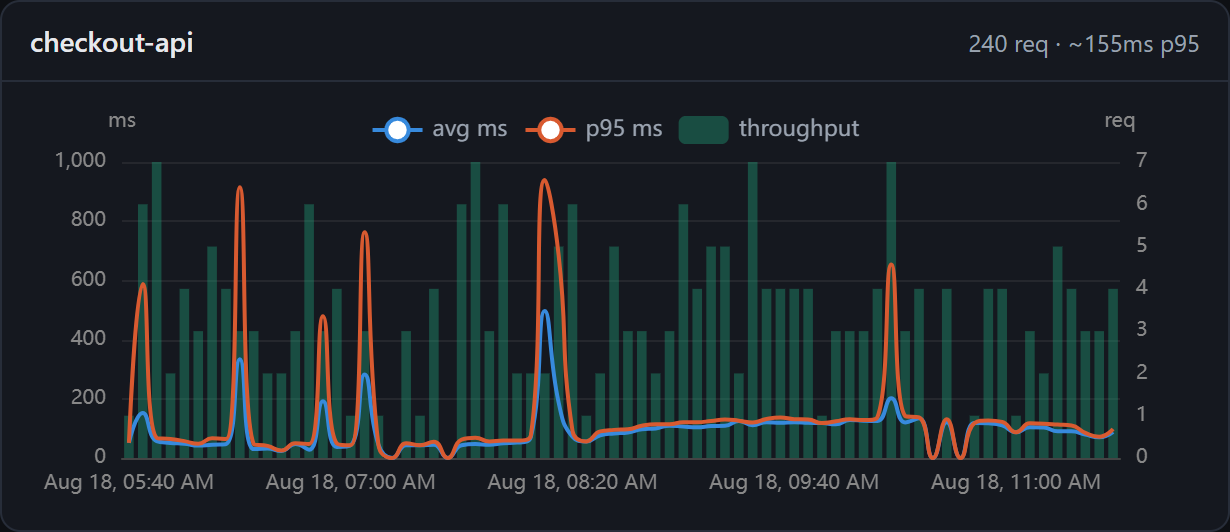
ZipLogger is the log management platform that doesn't stop at showing you errors — it parses the stack trace, blames your git history, and hands you the commit, the author, and an AI-written root-cause analysis. Search millions of logs in milliseconds. Own your data.
No credit card required · 14-day trial on paid plans · Self-hosted, your data stays yours
Built for teams who ship fast
Most log platforms end at search. ZipLogger connects the dots — from a spike of errors, to the pattern behind them, to the stack frame, to the exact line in the exact commit that introduced the bug.
ZipLogger parses file:line frames out of stack traces, runs git blame across your
connected repositories, and ranks the commits most likely to have caused the error — with the
author, the diff context, and an AI-suggested fix.
Ask questions in plain English and get real queries back. One click summarizes an error storm into a root-cause narrative. Powered by Claude, gated per plan, and always optional — the platform degrades gracefully without an API key.
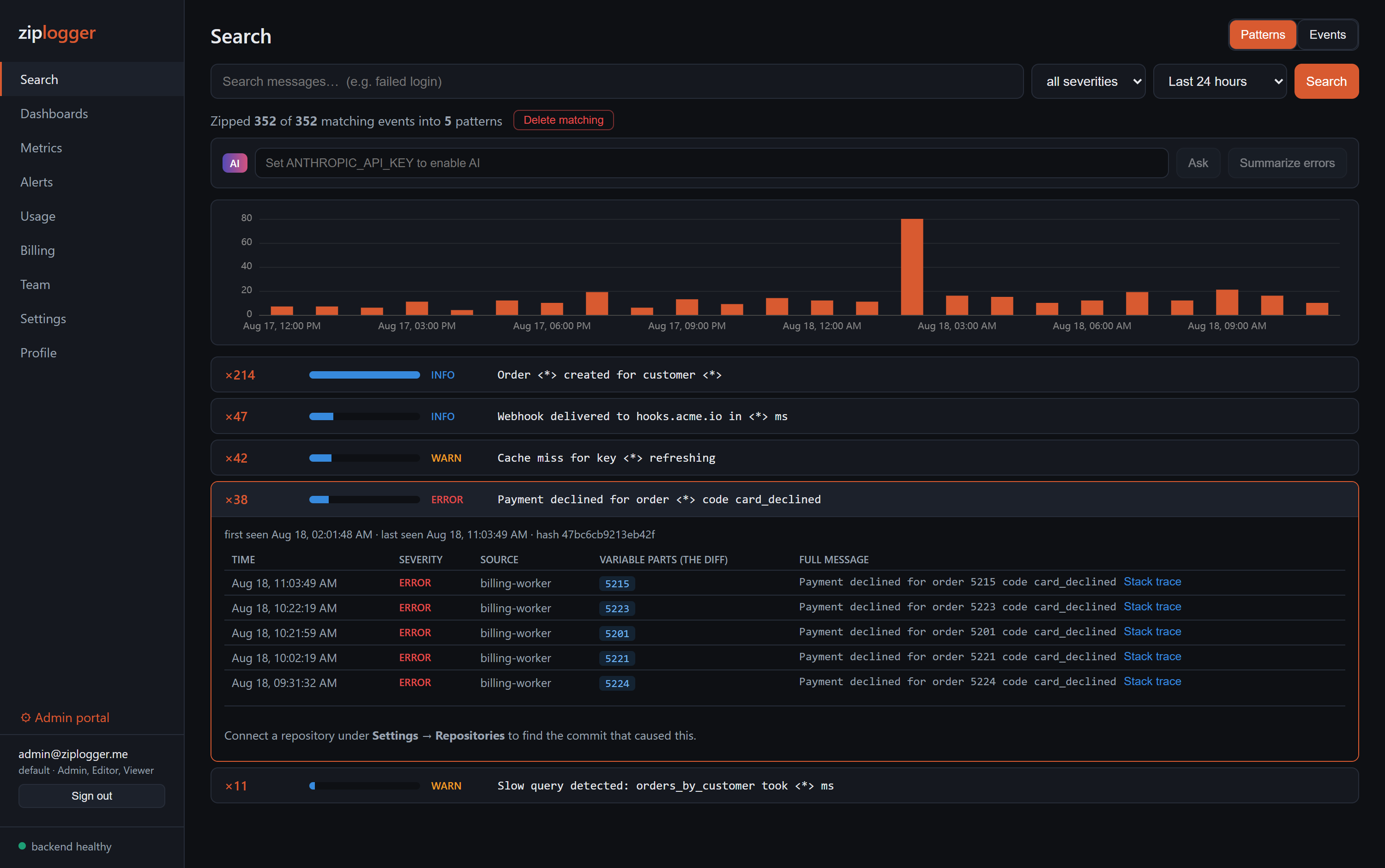
Our pattern engine collapses millions of similar log lines into a handful of templates and shows you only what varies. A 3 AM incident becomes ten patterns instead of 400,000 lines of noise.
Search stays fast no matter how much you log — full-text and structured queries answer in milliseconds across millions of events, with filters for severity, source, release, commit, and any custom field, plus live histograms to spot the spike at a glance.
# Query anything, instantly
severity:error source:checkout release:2.4.1
# …or just ask
"what went wrong after yesterday's deploy?"
→ 214 events · 3 patterns · 1 suspect commit
Official SDKs for .NET, Python, Node.js, Go, Java, and the browser — each plugging into the logging you already use — plus a native OpenTelemetry receiver and a plain NDJSON HTTP API for everything else. Batching, retries, backpressure, and enrichment are handled for you, the same way, everywhere.
builder.Logging.AddZipLogger(options =>
{
options.Endpoint = "https://logs.yourcompany.com";
options.ApiKey = "zk_...";
});
// structured logs, scopes and exceptions now flow
logging.getLogger().addHandler(ZipLoggerHandler(
endpoint="https://logs.yourcompany.com",
api_key="zk_...",
))
# extras become fields; tracebacks feed regressions
const logger = pino(pino.transport({
target: 'ziplogger/pino',
options: { endpoint: 'https://logs...', apiKey: 'zk_...' },
}))
// Winston transport included too
client, _ := ziplogger.New(ziplogger.Options{
Endpoint: "https://logs.yourcompany.com",
APIKey: "zk_...",
})
logger := slog.New(ziplogger.NewSlogHandler(client, slog.LevelInfo))
const zl = new ZipLoggerBrowser({
endpoint: 'https://logs.yourcompany.com',
apiKey: 'zk_...',
})
zl.captureGlobalErrors() // + React error boundary
Define threshold alerts on any query, evaluated continuously by a background engine, delivered to Slack or any webhook. Build dashboards from time-series, stat, and top-values panels — no extra product, no extra bill.
Millisecond full-text and structured queries with live histograms.
Natural-language search and one-click error summaries with root causes.
Stack traces blamed against your repos — suspect commits, ranked.
Millions of lines collapsed into patterns; only the differences shown.
Timeseries, stat, and top-values panels on any query you can write.
Continuous evaluation, Slack/webhook delivery, full firing history.
Fields, tags, releases, and commit SHAs — first-class and searchable.
Native OTLP/HTTP receiver — protobuf and JSON, gzip, partial success.
Early adopters on what changed for them. (Placeholder testimonials — real ones coming as the beta grows.)
“The regression view is unreal. An error spiked at 2 PM, ZipLogger pointed at a config refactor merged at 11 AM, and it was right. We reverted before most users noticed.”
“We replaced a $700/month bill with a ZipLogger instance on a server we already had. Setup took one afternoon, integration was one package. Search is faster than what we left.”
“Pattern view turned a 400k-line incident into ten templates. I finally stopped grepping and started reading. The AI summary was accurate enough to paste into the postmortem.”
Three ways. First, git regression detection: ZipLogger connects errors to the commits that caused them — nobody else closes that loop out of the box. Second, it's self-hosted: your logs stay on your infrastructure, with transparent flat pricing instead of per-GB surprises. Third, the SDKs behave identically across .NET, Python, Node.js, Go, Java, and the browser — learn the integration once, use it in every service you run.
Yes — 1,000 logs/day with 5-day retention, dashboards, and alerts, free forever. It's enough for a side project or a proper evaluation. Paid plans start at $5/month and add AI analysis, git regression detection, longer retention, and much higher volume, each with a 14-day free trial.
One modest server or VM — any cloud or on-prem. Installation is a guided, single-command setup that takes about ten minutes, and everything ZipLogger needs is included. Your logs stay on your infrastructure, under your control, from day one.
Official SDKs cover .NET (ILogger, Serilog), Python (logging),
Node.js (Pino, Winston), Go (slog), Java (java.util.logging), and the
browser (with a React error boundary) — every one dependency-free with identical batching and
retry behavior. Everything else can send logs through the OpenTelemetry OTLP receiver, Fluent
Bit/Vector pipelines, or the plain NDJSON HTTP API — if it can POST JSON, it can log to ZipLogger.
AI features call the Anthropic API with a bounded sample of the logs you explicitly ask it to analyze — nothing is sent in the background. It's enabled per plan and only if you configure an API key; without one, every other feature works normally.
Yes. Every tenant has a plan with daily and monthly log quotas, storage and AI limits, and
feature flags. Limits are enforced at ingestion with clear 429 + Retry-After
responses, and the SDKs handle throttling gracefully so your apps never block.
Set up ZipLogger in minutes, send your first log with two lines of code, and see which commit your next incident traces back to.